
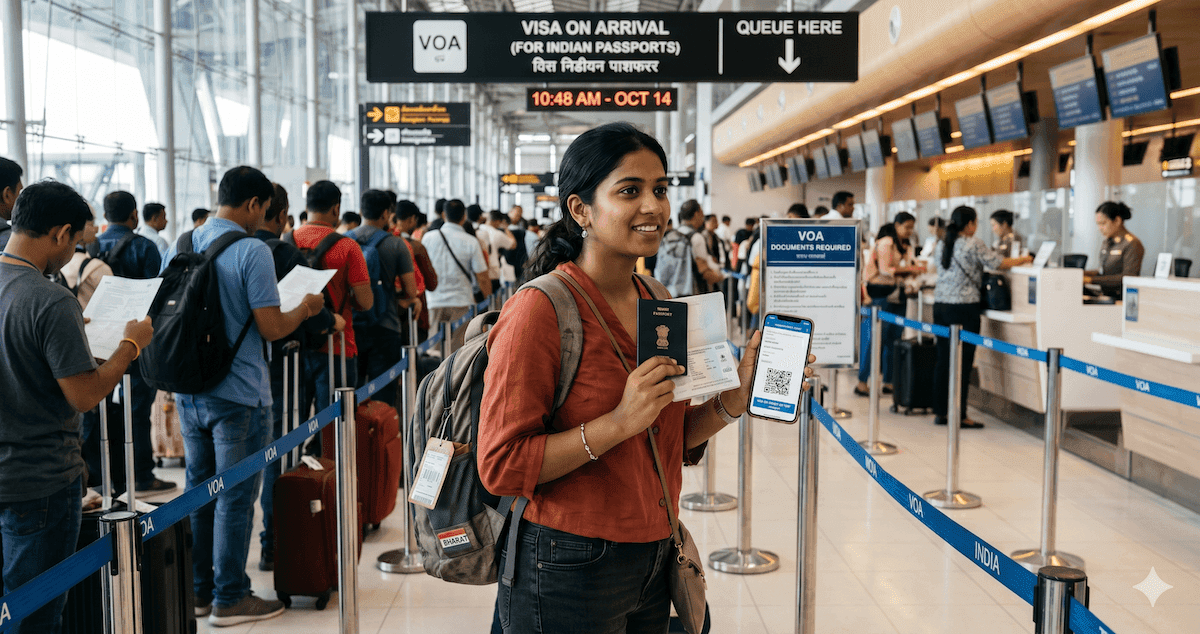
Thailand Visa Changes for Indians in 2026: What Exactly Changed?
Thailand has scrapped the 60-day visa-free entry for Indians. Find out what changed, the new Visa on Arrival rules, TDAC requirements. Full List on DocuPro
Thailand Visa Changes for Indians in 2026: What Exactly Changed?
Quick SummaryAs of May 19, 2026 — India is no longer on Thailand's visa-free list. Indian travellers need a Visa on Arrival again (2,000 THB, ~₹5,000), paid at the airport. The free 60-day stay is gone. All travellers must also complete the free TDAC digital form online before flying. Carry a confirmed return ticket and proof of funds. For trips longer than your VOA allows, use Thailand's official e-Visa system before you travel.
Thailand's Visa-Free Party is Over for Indians
The 60-day free stay is gone. Here's exactly what changed, what it used to be, and what you need to do before your next trip to Thailand.
For the last couple of years, travelling to Thailand as an Indian was genuinely easy. No visa, no fee, no appointment — just book your flight, show up, and you'd get a stamp good for 60 days. That era ended on May 19, 2026, when the Thai Cabinet officially approved a new policy that cuts visa-free access and brings back the Visa on Arrival requirement for Indians.
Don't panic though — Thailand hasn't shut its doors. You can still visit, and it's still one of the most Indian-friendly destinations in Asia. You just need to be a bit more prepared than before. This guide breaks down exactly what changed, what it was like before, and what you need to carry and do on your next trip.
Thailand - Visa on Arrival History for Indians.
To understand why this change feels like such a big deal, it helps to know how things used to work — and how dramatically they improved just two years ago.
Before 2024, Indians visiting Thailand needed a Visa on Arrival (VOA). You'd land at Bangkok's Suvarnabhumi airport, join a separate queue at the VOA counter, pay around 2,000 THB (roughly ₹5,000), fill out paperwork, and after a long wait, get a stamp for just 15 days. It worked, but it wasn't fun — especially after a long flight.
That changed in a big way. Starting November 2023, Thailand began a pilot visa-free programme for Indians — no fee, no queue, 30 days on arrival. Then in July 2024, they went even bigger: visa-free entry for travellers from 93 countries including India, with a stay of up to 60 days — extendable by another 30 days at a local immigration office. That's potentially 90 days in Thailand without ever applying for a visa.
As you'd expect, Indians loved it. Bangkok became the most-searched international destination for Indian travellers, with India quickly becoming one of Thailand's fastest-growing tourist markets.
Thailand Visa Changes for Indians in 2026: What Exactly Changed?
Here's the big news: India is no longer in the visa-free category. The Thai Cabinet's May 2026 decision doesn't just trim the 60-day window — it moves India into a much smaller, separate bucket called Visa on Arrival. And this time, the VOA list is tiny: only four countries globally get it — India, Azerbaijan, Belarus, and Serbia.
For everyone else in those 93 visa-free countries, access stays — but the stay is cut from 60 days down to 30 days. A few smaller nations like the Maldives, Mauritius, and Seychelles get just 15 days.
Thailand Visa for Indians: Before vs. After (Full Comparison)
| What We're Comparing | Before 2024 (Old Rules) | 2024 – March 2026 | May 2026 Onwards |
|---|---|---|---|
| Entry Type | Visa on Arrival (VOA) | Visa-Free (60 days) | Visa on Arrival (VOA) |
| Stay Duration | 15 days | 60 days (+ 30-day extension possible) | 15–30 days (details to be confirmed) |
| Visa Fee | ₹5,000–6,000 approx. (2,000 THB) | Free | Fee reinstated - 2,000 THB at port of Entry (Approx ₹5,000) |
| Advance Application | Not required; processed on arrival | Not required | VOA processed on arrival; e-Visa option being expanded |
| Arrival Card | Paper TM.6 form | Paper TM.6 (until May 2025); then TDAC | TDAC mandatory (digital, pre-arrival within 72 hrs) |
| Extension Possible? | Yes, limited | Yes — 30 extra days at immigration (1,900 THB) | Extension available; longer stays need e-Visa |
| Land Border Entry | Available, separate rules | Limited to 2 per calendar year; 60-day stamp | Stricter monitoring; same annual limits apply |
| Repeat Entries | Generally permitted | Flagged if back-to-back; could result in denial | Actively monitored; border-hop abuse penalised |
| Proof of Funds | Rarely checked | 10,000–20,000 THB per person required | 10,000–20,000 THB per person; stricter enforcement |
| Countries in Same Category | 31 nations on VOA list | 93 nations visa-free | Only 4 nations on VOA (India, Azerbaijan, Belarus, Serbia) |
What Is the TDAC and Why Do All Indian Travellers Need It Now?
Even before the May 2026 visa changes, there was already one new rule that applies to every single person entering Thailand — including Indians. It's called the Thailand Digital Arrival Card (TDAC), and it's been mandatory since May 1, 2025.
Think of it as a digital version of the old paper form you used to fill out on the plane. Except now you have to do it online, before you even board your flight.
How to complete the TDAC Go to tdac.immigration.go.th— it's the official Thai government portal, and it's free. Fill it out within 72 hours of your departure. You'll get a QR code — save it on your phone or print it. Immigration staff scan it when you land. Missing this step will slow you down at the airport.
You'll need to provide your Thai accommodation address, proof of a return ticket (open-ended tickets don't count), and evidence of enough money for your trip — about ₹25,000–50,000 per person depending on family size. Airlines flying from Indian cities like Delhi, Mumbai, and Bengaluru now check for TDAC completion at the gate before boarding, so you can't skip it and sort it out later.
Why Did Thailand Tighten Its Visa Rules? The Real Story
xThailand didn't do this just to be difficult. There were some genuine problems that the generous 60-day window created — and they built up fast.
The biggest issue: people were staying in Thailand on tourist entries and working unofficially — some doing remote gigs for foreign companies, others quietly running small businesses. The Thai Hotels Association flagged a big rise in condominiums being sublet to long-stay foreigners, undercutting the legitimate hotel industry. And then there's the classic "border hop" trick — where someone would leave Thailand, pop into a neighbouring country for a day, come back, and reset their 60-day clock. Immigration saw the pattern and cracked down.
Overstay numbers also went up noticeably after the 60-day window opened. Thailand wants its growing e-Visa platform to handle long-stay visitors properly — not have people working around the tourist entry system indefinitely.
There's also the economic pressure. Tourism makes up more than 10% of Thailand's GDP, and numbers haven't fully recovered post-pandemic. Arrivals dipped about 3.4% in early 2026. So this is a calculated call — tighten up, cut the abuse, but keep genuine tourists flowing.
Thailand Visa on Arrival for Indians 2026: Your Pre-Travel Checklist
Planning a trip to Thailand this year? Here's everything you need sorted before you fly:
- Complete the TDAC before flying — do it at tdac.immigration.go.th within 72 hours of departure. Don't leave it to the last minute; the system can slow down during busy periods.
- Carry 2,000 THB cash for the Visa on Arrival — that's roughly ₹5,000. Some counters accept cards but cash is safer and faster.
- Show proof of funds — a bank statement or cash showing at least ₹25,000 for solo travellers or ₹50,000 for a family is what immigration expects.
- Book a fixed return ticket — an open or flexible ticket, or one going to a neighbouring country, won't satisfy the exit requirement. You need a confirmed return date.
Want to stay longer in Thailand than your VOA allows?
Apply for a Tourist e-Visa through Thailand's official portal before you leave India — far easier than sorting it out once you're there.
No border hops — immigration actively tracks repeated entries. If you've been doing this to reset your stay, it won't work anymore and could get you rejected.
Working remotely from Thailand? Even remote work on a tourist visa is technically not allowed. Look into Thailand's Digital Nomad Visa (DTV) — it's designed for exactly this, with stays up to 180 days and remote work explicitly permitted.
Overstay Warning — The Penalties Are No Joke
Overstaying in Thailand even by a little has real consequences.
- Under 90 days of overstay = 1-year ban.
- 90 days to 1 year = 3-year ban
- Over 1 year = 10-year ban.
These kick in every time you try to cross an official Thai border.
Is Thailand Still Worth Visiting for Indians Despite These Visa Changes?
Honestly, yes — and here's the perspective check. If you're going to Thailand for a regular holiday, family trip, or a week by the beach, this change really isn't that dramatic. The VOA queue has gotten smoother over the years, you pay ₹5,000 once, fill out a form online before you fly, and you're sorted. Bangkok, Phuket, Chiang Mai, and Krabi are all still there waiting for you.
The people this actually disrupts are those who were using the 60-day free window as a lifestyle workaround — repeatedly entering on tourist stays, border hopping to reset the clock, or working without the right authorisation. For regular travellers, it's a small inconvenience, not a dealbreaker.
Thailand is also building up its e-Visa infrastructure, which should make longer, properly planned trips easier and more straightforward in the not-too-distant future. A solid digital visa platform means less grey area and clearer rules for Indians who want extended stays.
The door is still open — it's just got one more step at the entrance now.