
e-OCI Card 2026: What the New Digital OCI System Means for Overseas Indians
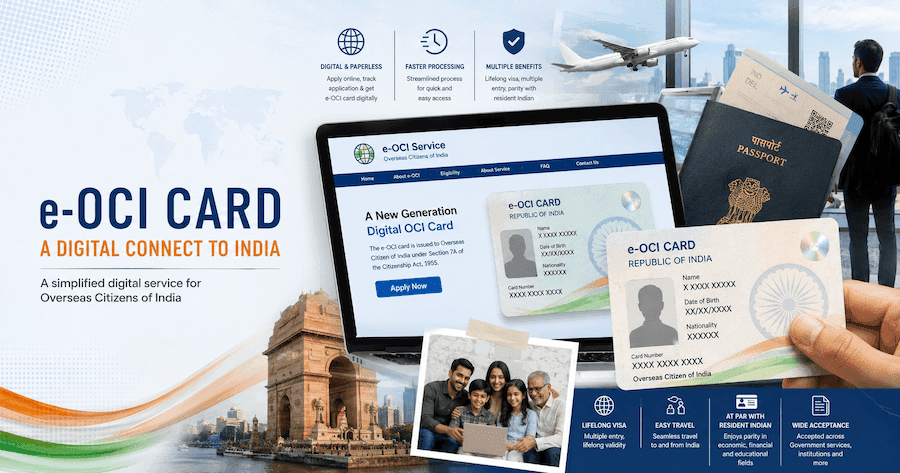
India has launched the e-OCI card, replacing the physical OCI booklet with a QR-coded digital credential. Here's what changed, who's affected?
e-OCI Card 2026: What the New Digital OCI System Means for Overseas Indians
For nearly two decades, the blue-grey OCI booklet has been a constant travel companion for millions of people of Indian origin living abroad. That's changing. On 30 June 2026, Union Home Minister Amit Shah launched the e-OCI card — a fully digital version of the Overseas Citizen of India credential — describing it as the most significant overhaul of the OCI programme since it began in 2005.
If you or a family member holds an OCI card, or you're planning to apply for one, this update changes how you'll apply, renew, update your passport details, and even clear immigration at Indian airports. Here's a complete breakdown of what's new, what stays the same, and what you need to do next.
1. What Is the e-OCI Card?
The e-OCI is a digitally generated OCI credential carrying a QR code linked directly to government records. Instead of carrying the physical booklet, cardholders can generate and store the e-OCI on a smartphone and present it at immigration counters and to airlines.
This isn't a separate scheme — it's the digital equivalent of the same OCI status you already hold or are applying for. The QR code allows immigration officers to verify your details instantly, cutting down manual checks and reducing the chances of document fraud.
Good to know: More than 50 lakh (5 million) OCI cardholders worldwide are covered by this transition, and most existing holders don't need to file a fresh application to access the digital version.
2. Is the Physical OCI Booklet Still Valid?
Yes — this is the point most cardholders get wrong. The government has been explicit that existing physical OCI booklets remain valid. The e-OCI is a parallel, more convenient option, not a replacement that invalidates your current card.
That said, the practical direction of travel is clear: new applications and renewals are increasingly routed through the digital system, and the physical booklet is no longer mandatory for immigration clearance. If you're applying fresh, you'll likely receive an e-OCI by default, with the physical card now optional rather than automatic.
3. The Legal Backbone: Citizenship (Amendment) Rules, 2026
The e-OCI launch sits on top of a broader legal overhaul. The Ministry of Home Affairs notified the Citizenship (Amendment) Rules, 2026, amending the Citizenship Rules of 2009 for the first time in over a decade. Key changes under this notification include:
- All OCI registration and renunciation applications must now be filed electronically through the official portal — physical, paper-based applications are being phased out.
- A central electronic registry of OCI holders has been introduced for better tracking and data management.
- On renunciation of OCI status, the individual must still surrender the original physical card (if one was issued) to the nearest Indian Mission, Post, or Foreigners Regional Registration Officer.
- A minor child cannot hold an Indian passport and a foreign passport at the same time — parents must formally declare compliance with this at the time of application.
4. No More Mandatory Booklet Reissuance After a New Passport
This is arguably the most welcome change for long-term OCI holders. Previously, every time a cardholder above the age of 20 received a new foreign passport, they had to apply for a fresh OCI booklet — a process that typically took 6 to 8 weeks and required a full re-issuance fee and paperwork.
Under the new system, cardholders simply update their new passport details online through the OCI portal. There's no physical re-issuance, no VFS appointment, and no fee for the update itself.
However, there's a firm compliance catch: cardholders must complete this online update within three months of receiving a new passport. Miss the deadline, and a fine of USD 25 (or the local currency equivalent) applies. This is a new compliance obligation that didn't exist before, so it's worth setting a reminder the moment your passport is renewed.
5. Faster Processing Timelines
The digital system also cuts down processing time considerably:
| Process | Earlier Timeline | Under e-OCI System |
|---|---|---|
| Fresh OCI issuance | 6–8 weeks (physical booklet) | Around 15 business days |
| Passport detail update | Full re-issuance required | Online update, no re-issuance |
| Application format | Submitted in duplicate | Single digital submission |
The requirement to submit OCI applications "in duplicate" has also been removed entirely, since the entire process — application, document upload, verification, and issuance — now runs online.
6. No More Six-Month Stay Requirement for In-India Applicants
Another practical relief applies to eligible foreign nationals applying for OCI while already in India. Earlier, applicants were often told, informally, that they needed to complete six months of "ordinary residence" in India before applying — a requirement that caused confusion and delays, since it wasn't clearly defined in law.
Effective 8 April 2026, the Bureau of Immigration has clarified that eligible applicants with a valid long-term visa and the required documents can apply for an OCI card soon after arriving in India, without waiting out any minimum stay period.
7. Broader Eligibility for Sri Lankan Tamils of Indian Origin
The revised rules have also widened eligibility for one specific diaspora group. Fifth- and sixth-generation Indian-origin Tamils in Sri Lanka can now apply for an OCI card — a category that was previously restricted to fourth-generation descendants only.
8. The End of the PIO Card
If you're still holding on to an old Person of Indian Origin (PIO) card, it's time to act. The government has officially discontinued the PIO scheme, and PIO cards are no longer accepted as valid travel documents. Anyone still using a PIO card must convert to OCI status to continue availing the associated benefits.
9. Faster Immigration: Fast-Track e-Gates
For frequent travellers, the e-OCI system connects to India's Fast-Track Immigration Programme. Enrolled e-OCI holders can use automated facial-recognition e-gates at Delhi, Mumbai, and Bengaluru airports, skipping the manned immigration counter altogether. The government has indicated that facial-recognition lane access will expand further by the end of 2026.
Separately, OCI cardholders travelling to India are now required to complete a Digital e-Arrival Card before boarding, since the physical disembarkation form has been discontinued permanently.
10. Application Fees: What's Changed and What Hasn't
The core OCI application fee structure hasn't changed. Fresh applications continue to cost the equivalent of USD 275 outside India, and ₹15,000 for applications filed within India (payable via demand draft in favour of the "Pay and Accounts Officer (Secretariat), Ministry of Home Affairs," New Delhi). Indicative fees in a few countries:
- UAE: Approximately AED 1,010
- Singapore: SGD 349
- Canada: CAD 376
- UK (via VFS Global): Approximately £215 plus service charges
What's new is the ₹15,000 in-India fee schedule taking effect from 1 April 2026, alongside the online passport-update process, which — unlike a fresh application — does not attract the full fee.
11. How to Get Your e-OCI Card (Existing Holders)
If you already hold an OCI card, generating your digital version is straightforward:
- Step 1: Visit the official OCI Services Portal at ociservices.gov.in.
- Step 2: Log in using the credentials linked to your approved OCI application.
- Step 3: Open the "e-OCI" tab on your dashboard.
- Step 4: Generate and download your e-OCI card as a PDF.
- Step 5: Save the file to your phone so it's accessible without internet access at immigration counters.
A practical tip for your first few trips after switching: carry the physical OCI booklet as backup, and make sure the name and passport number on your e-OCI match the passport you're actually travelling on.
12. What This Means If You're Applying for the First Time
New applicants — typically those who've naturalised as citizens of the US, UK, Canada, Australia, New Zealand, or the UAE — now go through an entirely online workflow. Documents are uploaded digitally, verification happens through the portal, and for children, apostille of birth certificates has become a specifically flagged requirement in the fresh application process.
One area where the rules have tightened rather than loosened: OCI applications tied to marriage now face stricter scrutiny, aimed at preventing misuse of OCI status through fraudulent marriages. The renunciation process, by contrast, has been simplified, and authorities can now cancel OCI status even without physical card surrender in certain cases.
13. Common Questions Parents and Cardholders Are Asking
Do I need to convert my physical OCI to e-OCI? No — there's currently no conversion requirement. Your existing paper OCI remains valid indefinitely unless it's revoked.
My child has an OCI card — does anything change for them? The dual-passport restriction for minors is the key point to note: a minor cannot hold both an Indian passport and a foreign passport simultaneously, and parents must declare compliance at the time of any related application.
What if I don't update my passport details within three months? A fine of USD 25 (or local equivalent) applies. Beyond the penalty, mismatched passport and OCI details can also cause friction at immigration.
14. FCRA 2.0: A Related Launch Worth Knowing About
The e-OCI card wasn't launched in isolation. Alongside it, the government rolled out the FCRA 2.0 Portal, an upgraded compliance platform for organisations receiving foreign contributions under the Foreign Contribution Regulation Act. This is primarily relevant to NRIs and OCI holders who donate to or work with NGOs, religious institutions, or non-profits registered in India.
The portal is hosted on MeghRaj, the National Government Cloud, and integrates with PAN, Aadhaar, OCI, NGO Darpan, and the ICAI's UDIN system. It's worth noting that donations themselves are governed by FEMA, not FCRA — the compliance burden sits with the receiving Indian organisation, not with the person sending money from abroad. Still, if a trust, temple, or school you regularly support has faced FCRA-related delays in the past, this digitisation is meant to smooth that friction over time.
How DocuPro Helps
Between the new digital portal, updated forms, apostille requirements, and firm compliance deadlines, the e-OCI transition brings real convenience — but also new ways to make a costly mistake. A missed passport-update deadline, an incorrectly apostilled document, or a fresh application filed under the wrong process can mean delays, penalties, or rejection.
DocuPro helps NRI and OCI families navigate the updated OCI system end-to-end — from generating your e-OCI and updating passport details on time, to preparing fresh applications and coordinating document apostille and attestation. Whether you're based in Bangalore, Hyderabad, Delhi, Mumbai, Chennai, Noida, or Gurgaon, or applying on behalf of family abroad, our documentation team handles the portal work and paperwork so you don't have to.
Conclusion: A More Convenient, More Compliant OCI System
The launch of the e-OCI card marks the biggest change to India's OCI programme since it was introduced in 2005. For most cardholders, the news is good: faster processing, no more mandatory booklet reissuance after a passport renewal, and smoother immigration through fast-track e-gates.
The trade-off is a tighter compliance clock — a three-month window to update passport details, stricter scrutiny for marriage-based applications, and a fully digital application process that leaves less room for paperwork shortcuts. Understanding which rules apply to your situation, and acting within the new deadlines, is the difference between enjoying the convenience and getting caught out by it.